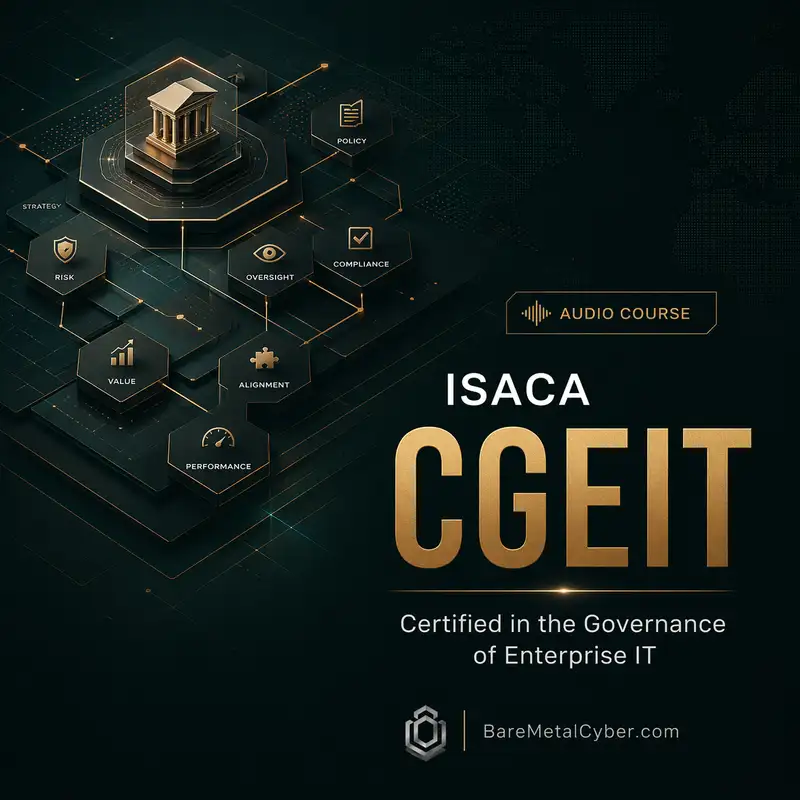
Episode 2 — Define what “governance of enterprise IT” means in daily leadership decisions (1 Governance of Enterprise IT)
In this episode, we’re going to make the phrase governance of enterprise I T feel concrete and practical, because beginners often hear it and picture committees, paperwork, or vague executive talk. The reality is that Governance of Enterprise IT (G E I T) shows up anytime an organization decides what I T should do, what it should not do, who gets to decide, and how the organization knows whether the decisions worked. When people skip this meaning and jump straight to frameworks and terminology, they end up memorizing words without understanding why those words exist. Our goal is to build a plain-language definition you can carry into every later topic, so that when you hear a new governance concept, you can connect it to everyday leadership decisions. By the end, you should be able to explain G E I T as a simple set of leadership behaviors that turn technology choices into reliable business outcomes.
Before we continue, a quick note: this audio course is a companion to our course companion books. The first book is about the exam and provides detailed information on how to pass it best. The second book is a Kindle-only eBook that contains 1,000 flashcards that can be used on your mobile device or Kindle. Check them both out at Cyber Author dot me, in the Bare Metal Study Guides Series.
A strong beginner definition starts with the idea that governance is not the same thing as doing the work, and it is not the same thing as managing a team’s daily tasks. Governance is the act of setting direction, deciding who has authority, and making sure there is accountability for results, even when things go wrong. In the context of I T, that means leaders decide what outcomes the organization expects from technology, how much risk is acceptable, and how resources like budget and staff time should be allocated. If management is steering the car and pressing the pedals, governance is deciding where the car is allowed to go, how fast is safe, who is licensed to drive, and what happens if there is an accident. That difference matters on the exam because many scenarios offer answers that sound helpful operationally but fail to establish the authority and oversight that define governance. When you define governance this way, it becomes easier to spot which choices belong to leadership and which belong to execution.
Now add the enterprise part, because that single word changes everything. Enterprise means the whole organization, not just one department, one team, or one project, and it implies shared priorities and shared consequences. A decision that helps one team can still be a poor enterprise decision if it creates hidden costs, duplicates work, or increases risk somewhere else. When you hear enterprise, think about tradeoffs that affect multiple groups, like finance, legal, operations, customer support, and security, not only the I T staff. This is why G E I T is often discussed at senior levels, because enterprise tradeoffs usually require someone who can weigh competing interests and make a choice that aligns with the organization’s direction. For beginners, it helps to remember that enterprise decisions are judged by how they affect the whole system over time, not just whether they make a single project finish faster. Governance exists to make those system-level decisions consistent and explainable, instead of accidental and chaotic.
To complete the definition, you need to understand what I T means in a governance context, because it is broader than laptops, servers, and software. I T includes the systems that store and move information, the platforms that run business processes, the data that fuels decisions, and the digital services customers and employees depend on. It also includes the rules and practices that keep those systems reliable, safe, and usable, even under stress. When an organization chooses an I T direction, it is often choosing how it will operate, how it will compete, and how it will protect itself, whether leaders realize it or not. That is why governance of I T is not only about technology quality, but also about value, risk, and alignment with business goals. A beginner-friendly way to say it is that I T is the engine and nervous system of the enterprise, and governance is how leaders decide what that system is allowed to do and how it must behave. When you link those ideas, G E I T starts to feel like leadership reality, not an abstract certification phrase.
A practical definition of G E I T can be stated in one sentence you can reuse: it is the set of leadership decisions and oversight practices that make sure I T supports the enterprise’s goals, delivers measurable value, and stays within acceptable risk. Notice what that sentence includes and what it does not include. It includes leadership decisions, meaning authority and accountability are central. It includes support for enterprise goals, meaning I T is not allowed to drift into whatever is interesting or convenient for technical teams. It includes measurable value, meaning success is defined in outcomes, not effort or activity. It includes acceptable risk, meaning governance is not about eliminating all risk, but about deciding which risks the enterprise is willing to take and which ones it is not. If you can explain those four pieces, you can answer many foundational questions because most governance scenarios test one of those elements.
To make this real, consider what a daily leadership decision looks like when it involves I T, even if nobody calls it governance. Imagine a department asks for a new system to speed up work, and the request seems reasonable, but it overlaps with an existing platform and would create duplicate data. A manager might be tempted to approve it quickly to keep the department happy, but a governance-minded leader asks enterprise questions: who owns the data, how will integration work, what risks are introduced, and how will value be measured. The governance decision might be to route the request through an enterprise review, not to slow things down for fun, but to protect the organization from long-term fragmentation. Another example is a decision about whether to accept a shortcut in security to meet a deadline, which is not only a technical choice but a risk acceptance decision that should have clear authority. In both cases, the daily decision is the moment governance happens, because someone is defining priorities, risk tolerance, and accountability. G E I T is the habit of making those decisions deliberately instead of accidentally.
Beginners also need to understand that governance is about decision rights, which is a simple phrase with big impact. Decision rights mean who has the authority to decide something and who is responsible for the outcome, and the two are not always the same unless governance makes them explicit. Without clear decision rights, organizations fall into predictable problems like endless meetings, conflicting priorities, and decisions that nobody owns when they go wrong. With clear decision rights, decisions can be made faster because people know when they can decide locally and when they must escalate. This is why governance can actually increase speed, even though people sometimes assume governance is bureaucracy. When the exam asks about improving governance, correct answers often involve clarifying authority, defining accountability, and establishing escalation paths for conflicts. If you keep decision rights in mind, you will start to notice that many I T problems are not technical at their core, but are governance problems disguised as technical pain.
Another key part of G E I T is oversight, which means the enterprise does not just decide once and hope for the best. Oversight is how leaders confirm that I T is delivering what was promised, staying within risk limits, and adjusting when reality changes. This includes monitoring performance indicators, reviewing major initiatives, and checking that controls and policies are followed in practice, not only on paper. Oversight also includes learning from failures, which is important because governance is not perfect prediction, it is responsible adaptation. When a project goes over budget, governance questions include whether the business case was sound, whether decision makers had accurate information, and whether the organization recognized warning signs early. When a system outage happens, governance questions include whether resilience expectations were defined and whether accountability for service reliability was clear. Beginners often focus on the technical cause of a failure, but governance focuses on whether the organization created conditions that made failure more likely or less likely. That perspective is central to the meaning of G E I T.
Value is another word that can feel fuzzy, so we will make it concrete in a governance definition. Value means the benefits the enterprise expects from I T, and those benefits can be financial, operational, or strategic. Financial value might be cost reduction or revenue growth, operational value might be faster processing or fewer errors, and strategic value might be the ability to launch new services or enter a new market. Governance requires that value is defined before large investments are approved, because otherwise the organization cannot tell whether I T is succeeding. Many organizations fall into a trap of measuring activity, like how many systems were deployed, instead of outcomes, like how much customer wait time dropped. G E I T pushes leaders to ask what success looks like in measurable terms and to track whether the expected benefits actually appear. This does not mean every benefit can be measured with perfect precision, but it does mean leaders must define what they will look for and how they will know if they are on track. When you connect value to governance, you see that governance is a disciplined approach to making I T worth the investment.
Risk is the partner concept to value, and in governance it means more than cybersecurity, even though cybersecurity is often a major part of it. Risk includes the chance of service failures, compliance problems, data quality issues, vendor lock-in, cost overruns, and strategic misalignment, among many others. Governance does not demand that leaders eliminate risk, because eliminating all risk would stop progress, but it does demand that leaders decide which risks are acceptable and which require mitigation. That decision must be explicit, because silent risk acceptance is one of the most common enterprise failures. When someone approves a system without understanding its data privacy implications, that is a governance failure, not only a security gap. When an organization keeps aging systems running without a plan, that is risk acceptance by neglect. G E I T is the practice of making risk decisions visible, owned, and tied to enterprise priorities, so that the organization can move forward responsibly. If you can explain risk in this broad way, you will better understand why governance questions often include compliance and assurance themes.
Alignment is the last major piece of the practical definition, and it is often the easiest to misunderstand. Alignment does not mean that I T always says yes to the business, and it does not mean that the business always understands every technical detail. Alignment means I T direction and decisions support the enterprise’s goals and constraints, so technology becomes a lever for the strategy rather than a disconnected collection of projects. For example, if the enterprise strategy is to improve customer experience, alignment might mean prioritizing system reliability and data consistency over flashy new features. If the strategy is to expand rapidly, alignment might mean building scalable platforms and standard processes rather than custom solutions for every team. Alignment also means respecting constraints like budget limits, regulatory requirements, and risk tolerance, because strategy is always shaped by what the enterprise can and cannot accept. Governance provides the mechanism to translate strategy into priorities and to resolve conflicts when different groups want different things. When you hear alignment in this course, think of it as keeping technology decisions connected to enterprise direction in a way that can be explained and defended.
It is also important to address what G E I T is not, because wrong assumptions cause beginners to answer questions incorrectly. G E I T is not a single meeting, a single committee, or a single policy document that sits in a folder. It is not limited to the security team, and it is not only about audits, even though audits may check whether governance is effective. It is not the same as project management, because projects can be managed well while still being misaligned with enterprise priorities or making the enterprise more fragile. G E I T is not only about setting rules, because rules without oversight and accountability are just suggestions. The best way to remember what it is not is to think about outcomes: if a practice does not clarify decision rights, improve alignment, ensure accountability, or manage value and risk, it may be useful, but it is not governance in the sense the exam is testing. That clarity helps you avoid choosing operational fixes when a scenario is really asking for governance action.
To help you internalize the meaning in daily leadership decisions, picture a simple flow that leaders repeat, even if it is informal. Leaders set direction by defining what outcomes matter, then they allocate resources by choosing what gets funded and staffed, then they oversee delivery by monitoring whether results match expectations. Along the way, they manage tradeoffs by deciding what risks to accept and what constraints cannot be violated. They also enforce accountability by making sure someone owns the outcome and by requiring corrective action when performance falls short. This cycle happens in small ways every day, like approving a change, prioritizing a backlog, or resolving a conflict between departments, and it happens in big ways through investment planning and enterprise initiatives. G E I T is essentially that cycle made intentional, consistent, and enterprise-focused. When a leadership team practices this well, I T becomes more predictable and more valuable, and the organization wastes less energy on confusion and rework. When the cycle is weak, I T becomes a source of surprises, drift, and recurring crises that feel technical but are actually governance failures.
Finally, connect all of this to how you should think when you hear a scenario question, because that is where definitions become useful. When a question describes a problem, your first thought should be, which part of governance is missing or weak: direction, decision rights, oversight, value definition, risk acceptance, or alignment. Then evaluate answer choices based on whether they strengthen that missing piece at the enterprise level, not just whether they fix a symptom for one team. If an answer sounds like it is doing work, like building something or configuring something, ask whether the question really needed governance instead, like defining authority or establishing monitoring. If an answer creates a clear owner, a clear rule, and a way to measure outcomes, it often aligns with governance thinking. This mindset is especially helpful for beginners because it turns complex scenarios into pattern recognition. As you progress through the course, you will keep refining this definition, but the core idea remains stable: G E I T is enterprise leadership applied to I T decisions so that value, risk, and alignment are managed deliberately rather than by accident.
To close, you should now be able to define governance of enterprise I T as a leadership system for making, owning, and overseeing technology decisions in a way that serves the whole organization. That system is built from clear direction, clear decision rights, visible accountability, disciplined oversight, and an intentional balance between value and risk. In daily leadership life, it appears when someone decides priorities, approves funding, accepts risk, resolves conflicts, and demands evidence that promised benefits are real. It is not a synonym for management, security, or paperwork, even though it touches all of those areas, because its unique purpose is to make enterprise technology choices consistent, explainable, and aligned with the organization’s direction. As you move into later topics like frameworks, roles, and policies, keep returning to this definition, because it will help you hear each new concept as a tool that strengthens decision-making rather than as a standalone term to memorize. When you can consistently ask, how does this improve decision rights, oversight, alignment, value, or risk, you are already thinking the way the certification expects.